Let’s Talk: Kidney Health & Diabetes
A resource for healthcare heroes
 FOR HEALTHCARE PROFESSIONALS
Why we should all discuss diabetes-related kidney complications
When it comes to living well with diabetes, taking steps to reduce the risk of diabetes-related kidney complications and managing complications if they do arise are essential aspects of care. Complications shouldn’t be framed as inevitable, and it is vital that we support all people to have a long, healthful, and meaningful life, including for those managing complications.
In our 2024 study exploring how people with diabetes feel during conversations about diabetes-related complications, people reported that talking about diabetes-associated kidney complications (especially concepts like dialysis or kidney failure) can feel scary and overwhelming, and that conversations often rely on judgment- or fear-based messaging.1 In fact, kidney-related complications were among the most distressing topics for people with diabetes. This quick guide can help you navigate these conversations in a more respectful and hopeful way.2,3
Choosing stigma-free language
Diabetes-related complications are often one of the most difficult topics to discuss, and diabetes stigma can make those conversations harder and negatively impact care outcomes.1 How we talk about kidney health and complications can transform the conversation. Choose to use language that:
- is neutral, nonjudgmental, and based on facts, actions, or physiology/biology 2,3
- is strengths-based, respectful, inclusive, and imparts hope 2,3 because complications are manageable conditions
- is person-centered and focuses on the individual’s needs 2,3
- fosters collaboration between people with diabetes and their healthcare teams 2,3
For more language tips, explore our full-length language guide for diabetes-associated complications.
Having stigma-free conversations about diabetes-related kidney complications
1. Avoid fear-based messaging about kidney complications.
Conversations about diabetes-related complications like kidney disease can be challenging or spark feelings of anxiety about worsening health and loss of independence or normalcy. Fear and failure are also commonly used as motivators in discussions about kidney complications, especially around the concepts of dialysis, kidney failure, and kidney transplants,1 despite an understanding that fear-based messaging is demotivating and can lead people to avoid discussions about complications or diabetes management altogether.4
Aim to center conversations around living well with diabetes, evidence-based strategies to reduce risk and improve kidney health, and each person’s unique goals and motivators, such as staying healthy to spend more time with family.
2. Be mindful of past experiences and aim to make information about diabetes-related kidney complications clear.
Try to meet people where they are and take into account a person’s level of understanding, past healthcare experiences, challenges in diabetes self-management, and healthcare access. Be an active listener, encourage open sharing, and prioritize collaborative decision-making.
Bad uACR? Poor eGFR? Avoid value-based judgments and overly technical language when discussing lab results or metrics. Instead, aim to keep data points neutral, use exact values, and help make sense of what results mean for each unique individual’s management plan. Make managing risks and complications a regular part of the conversation instead of allowing fear or anxiety to build over time.
Try this: “Let’s talk about some additional approaches we can take to protect your kidney health now and in the future. There are many tools available to us, so let’s discuss what works best for your goals.” Instead of this: “You’re going to end up on dialysis if you don’t control your blood sugar.”
3. Offer support resources and help nurture strengths.
Living with complications can feel isolating. Self-stigma or internalized shame and guilt can be a major hidden challenge. If a person expresses these feelings, prioritize building resilience. Every person has unique strengths that can be used to support their diabetes management and defend against diabetes stigma and diabetes distress.
It may be helpful to involve additional support resources in the care plan, such as community support programs and mental health care professionals who specialize in strengths-based approaches, diabetes, or managing chronic health conditions.
Understanding Kidney Health
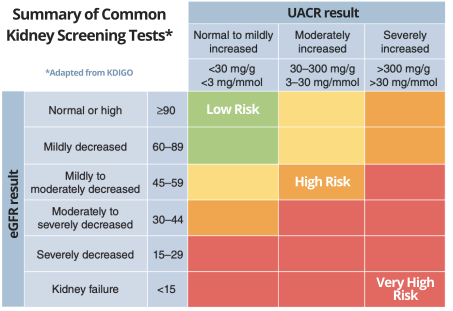
Two annual tests are recommended to help understand kidney function and damage and estimate chronic kidney disease (CKD) risk. Understanding what these tests are and what their results mean can help people focus on the facts and dispel fear or anxiety about the unknown.
This chart below (adapted from KDIGO) helps estimate the risk of kidney disease progression. Consideration of other risk factors is necessary.
- Urine albumin-to-creatinine ratio (UACR): measures protein (albumin) excretion in urine. Higher ranges indicate higher levels of kidney damage. Other factors, such as a urinary tract infection or menstruation, can elevate levels.
- Estimated glomerular filtration rate (eGFR): measures how well your kidneys are filtering waste products out of your blood. Lower ranges indicate kidney function is reduced. Some natural decline is expected with age.
Understanding Kidney Health
Diabetes isn’t the only risk factor related to kidney complications. Helping someone understand their full risk profile can lead to more targeted discussions and management plans. Other risk factors to consider discussing include:
- High blood sugar over a long period of time
- High blood pressure and/or cholesterol
- Heart disease
- Obesity
- Genetics and family history of kidney disease
- Black, Hispanic or Latino, American Indian or Alaska Native, Asian, or Pacific Islander ancestry
Try this: “There are a few tests that can help us measure your kidney function. Combined with our understanding of other risk factors, we can make tailored decisions together about how to protect your kidney health.”
This resource was created for dStigmatize, a diaTribe Foundation program, with support from Lilly, AstraZeneca, the Boehringer Ingelheim-Lilly Alliance, and Genentech.



Citations
- Garza, M., Cox, E., Wilson, K., & Morgan, A. J. (2024). 673-P: Impact of Language in Clinical Discussions of Diabetes-Related Complications in a Predominantly Non-White Sample. Diabetes, 73 (Supplement_1), 673–P.
- Dickinson, J. K., Guzman, S. J., Maryniuk, M. D., O’Brian, C. A., Kadohiro, J. K., Jackson, R. A., D’Hondt, N., Montgomery, B., Close, K. L., & Funnell, M. M. (2017). The Use of Language in Diabetes Care and Education. Diabetes care, 40(12), 1790–1799.
- Speight, J., Skinner, T. C., Dunning, T., Black, T., Kilov, G., Lee, C., Scibilia, R., & Johnson, G. (2021). Our language matters: Improving communication with and about people with diabetes. A position statement by Diabetes Australia. Diabetes research and clinical practice, 173, 108655.
- Speight, J., Skinner, T. C., Rose, K. J., Scibilia, R., & Boulton, A. J. (2020). Oh sugar! How diabetes campaigns can be damaging to the cause they aim to serve. The Lancet Diabetes & Endocrinology, 8(7), 566–567.