Let’s Talk: Diabetes & Eye Health
A resource for healthcare heroes
 FOR HEALTHCARE PROFESSIONALS
Why we should all discuss diabetes-related eye complications
When it comes to living well with diabetes, taking steps to manage or reduce the risk of diabetes-related eye complications is an essential aspect of care. The most common examples include diabetic retinopathy or diabetes-related retinopathy (DR), diabetic macular edema (DME), cataracts, and glaucoma. This resource focuses specifically on DR and DME.
diaTribe conducted internal research to explore how people feel during conversations about diabetes-related complications. Participants reported that talking about eye complications (especially concepts like vision loss) can feel scary and overwhelming, and that conversations often rely on judgment- or fear-based messaging.1 Many people walk away from these conversations feeling like their management efforts are hopeless. Ensure people know that early treatment and keeping up with diabetes self-management behaviors can help preserve vision and reduce the risk of other complications.
Eye health matters, so let’s talk about how we can navigate these conversations in a more respectful and hopeful way.2,3
Choosing the right words and phrases
Diabetes-related complications are often one of the most difficult topics to discuss, and diabetes stigma can make those conversations harder and negatively impact care outcomes.1 How we talk about eye health and complications can transform the conversation. Choose to use language that:
- is neutral, nonjudgmental, and based on facts, actions, or physiology/biology 2,3
- is strengths-based, respectful, inclusive, and imparts hope 2,3 because complications are manageable conditions
- is person-centered and focuses on the individual’s needs 2,3
- fosters collaboration between people with diabetes and their healthcare teams 2,3
For more language tips, explore our full-length language guide for diabetes-associated complications.
Having stigma-free conversations about diabetes and eye health
1. Avoid fear-based messaging about eye complications.
Fear and failure are commonly used as motivators in conversations about eye complications.1 Discussing diabetes-related complications can be challenging and scary; they often spark feelings of hopelessness, anxiety about worsening health, and a loss of independence or normalcy. Fear-based messaging can worsen these anxieties and lead people to avoid discussions about complications or diabetes management altogether which won’t help improve people’s health outcomes.4
Try this: “Let’s talk about some additional approaches we can take to protect your eye health now and in the future. There are many tools available to us, so let’s discuss what works best for your goals.” Instead of this: “You’re going to end up blind if you don’t control these bad blood sugars.”
2. Help people understand their eye health and management options to foster autonomy.
Most people want to better understand their eye health and how to protect it, but these topics are complicated and rarely explained in a way that feels approachable. Eye procedures can sometimes sound frightening, especially when someone is facing potential vision loss. Uncertainty or lack of information can compound fear and anxiety.
Try to meet people where they are and take into account a person’s level of understanding, past healthcare experiences, challenges in self-management, and barriers to access. Keep data points neutral, use exact values, and help make sense of what test results mean for each individual while avoiding value-based judgments or overly technical language. When managing risks and complications are a regular part of the conversation, you foster open sharing, autonomy, and collaborative decision-making.
Try this: “When we did your dilated eye exam we found ___. I know that can be concerning, so I want to make sure we walk through exactly what this means for you and what treatments are available.”
3. Identify signs of self-stigma or diabetes distress and facilitate a strengths-based approach to care.
Living with complications can feel isolating. Self-stigma or internalized shame and guilt can be a major hidden challenge. If a person expresses these feelings, try focusing on their unique strengths that support management and defend against diabetes stigma and distress. Remember, nobody chooses to get diabetes or a complication.
Try this: incorporate additional support resources, such as diabetes educators, community support programs, and mental health care professionals who specialize in strengths-based approaches, diabetes, or chronic health conditions.
Understanding Eye Health
What is Diabetes-Related Retinopathy?
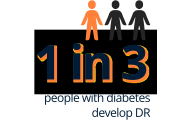
DR is a common complication that occurs when diabetes affects small blood vessels in the retina of the eye, causing them to leak, swell, or bleed. Managing blood sugar is an important way to reduce the risk of DR. Early on, many people experience minimal to no symptoms of DR, so attending annual eye exams and screening appointments is essential to protecting eye health.
What is DME?
DME is a common complication of DR in which damaged blood vessels cause leakage in the central part of the retina (known as the macula), causing fluid build-up and swelling. This central part of the retina is responsible for detailed, central vision. Symptoms include:

Who Should Get Checked?
Retinopathy is the leading cause of vision loss in people with diabetes, but it is often treatable. Regular screenings (like annual comprehensive, dilated eye exams with a retinal specialist) can help monitor eye health and detect signs of DR or DME.
How often should you have a comprehensive, dilated eye exam?
A comprehensive, dilated eye exam is recommended within 5 years of diagnosis, then annually going forward unless the doctor recommends more frequent exams.
A comprehensive, dilated eye exam is recommended immediately after diagnosis, then annually going forward unless the doctor recommends more frequent exams.
Comprehensive, dilated eye exams are recommended preconception or during the first trimester, with follow-ups throughout pregnancy.
This resource was created for dStigmatize, a diaTribe Foundation program, with support from Lilly, AstraZeneca, the Boehringer Ingelheim-Lilly Alliance, and Genentech.




Citations
- Garza, M., Cox, E., Wilson, K., & Morgan, A. J. (2024). 673-P: Impact of Language in Clinical Discussions of Diabetes-Related Complications in a Predominantly Non-White Sample. Diabetes, 73 (Supplement_1), 673–P.
- Dickinson, J. K., Guzman, S. J., Maryniuk, M. D., O’Brian, C. A., Kadohiro, J. K., Jackson, R. A., D’Hondt, N., Montgomery, B., Close, K. L., & Funnell, M. M. (2017). The Use of Language in Diabetes Care and Education. Diabetes care, 40(12), 1790–1799.
- Speight, J., Skinner, T. C., Dunning, T., Black, T., Kilov, G., Lee, C., Scibilia, R., & Johnson, G. (2021). Our language matters: Improving communication with and about people with diabetes. A position statement by Diabetes Australia. Diabetes research and clinical practice, 173, 108655.
- Speight, J., Skinner, T. C., Rose, K. J., Scibilia, R., & Boulton, A. J. (2020). Oh sugar! How diabetes campaigns can be damaging to the cause they aim to serve. The Lancet Diabetes & Endocrinology, 8(7), 566–567.